
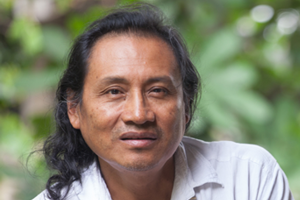
Gabriel Peredo-Albornoz (Uma Kanchariq, native name)
Proud Ainu-Quechua descendant, named Pachaqampiqamayuq (Healer of the Earth) by the Meeting of Wisekeepers of Ancestral Knowledge of Abya Yala. PhD student in Biodiversity Conservation and Management, Faculty of Sciences, Santo Tomás University (Chile), supervised by Dr. César Marín at Soil Laboratory, Centro de Investigación e Innovación para el Cambio Climático (CiiCC), from where he introduces experimental models to decode ancestral metaphors that can contribute to the prevention of climate or health crises. He has trained with representatives of indigenous and scientific knowledge such as Abadio Green Stocel, Carlos Barrios, Carlos Prado, Taita Shanti Agui, Fritjof Capra, Roberto Restrepo Arcila, Luis Eduardo Luna, and Rupert Sheldrake. He was an advisor to the national policy on Intercultural Community Family Health (SAFCI) and to the Kuska scientific mission at COP28. He was appointed as an expert to the Technical Committee of the Bill Declaration of Cultural, Material, and Intangible Heritage of Medicinal Plants (Echipnosis pachanoi, Banisteriopsis caapi, Psychotroia viridis, and Anadenanthera colubrina) of the Cámara de Senadores del Estado Plurinacional de Bolivia and the Declaration of Cultural and Natural Heritage of the Dr. Martín Cárdenas Botanical Garden. He is currently the Bolivian Focal Point for the Ikwashenduna Four Pillars Project (UNESCO) and the Talantaña Armonization Proposal (UCB). Invited as research member of the Centre International de Recherches et études Transdisciplinaires (France) advisored by Basarab Nicolescu. Currently collaborates with the Consejo de Pueblos Atacameños and the Comunidad Espiritual Andina de Wiracocha on projects related to agent-based modelling of medicinal plants for future pandemics and space medicine and some other research focus on ancient traditions: Bön and Nayjama as preceding conservation kinecology.

Comments